Berlin School

ContactImprint

Blog

Gravatar: Berlin School Admin

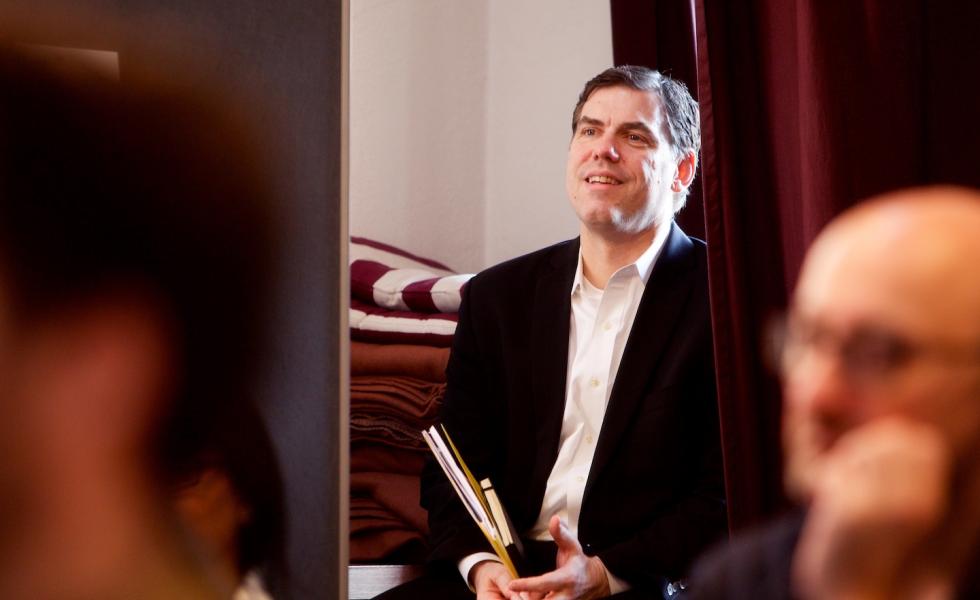
Jeff Jarvis President's Lecture now online.

Posted byBerlin School Admin16-Feb-2010 15:03 +CET

Jeff Jarvis President's Lecture now online.

Tags: 
Comment on this entry (0 comments so far)

Creative Faculty member's film at the Berlinale

Posted byClark Parsons16-Feb-2010 10:10 +CET

Creative Faculty member's film at the Berlinale

Congratulations to Joao Daniel Tikhomiroff for the Berlinale film festival screening of his new film, Besouro ("Beetle"), the biography of Brazil's most famous Capoeirista, Besouro Manganga.

Here's the Besouro trailer.


Joao Daniel directed the film, one of the largest productions in Brazilian history, which tells the story of Besouro's life and struggle to help free Brazil's ethnic African population from economic slavery in the 1920s. Besouro became a legendary master of the African-inspired fighting dance, which grew out of Afro-Brazilians' being unallowed to own weapons. With action director Huan-Chiu Ku (Kill Bill, Matrix) the film has spectacular stunt sequences and a soundtrack featuring Gilberto Gil, Rica Amabis, Tejo and other Brazilian stars.


Photo: Joao Daniel (left) at the Besouro premiere last night in Berlin with the film's stars Jessica Barbosa and Aílton Carmo

Last September Joao Daniel delivered a joint master class and President's Lecture at the Berlin School on the subject of Mixing -- the model he has developed for his company that spans advertising, TV and film production.

You can also watch Joao's Tent Talk on the subject with fellow Berlin School Creative Faculty member Tony Segarra.

Tags: 
Comment on this entry (0 comments so far)

Jeff Jarvis and Peter Guber - unexpectedly aligned

Posted byClark Parsons11-Feb-2010 10:10 +CET

Jeff Jarvis and Peter Guber - unexpectedly aligned

Two of the highlights of the recent USA module for the EMBA program were speaking appearances by Jeff Jarvis and Peter Guber.
One is a thought leader on the digital transformation and its affect on traditional media, especially print journalism. The other is a legendary Hollywood production company head, former studio boss and record label founder.

Our Faculty Director David Slocum listened closely to them and found some suprising similarities in their messages.

"For me, the crucial thread running through these shared ideas is a committed openness to change – in industries and institutions, in teams and in individuals, and perhaps most in the romantic ideas we tend to harbor about the individual leader or writer."

Read the whole post and David's list of parallels here.

Tags: 
Comment on this entry (0 comments so far)
Gravatar:

One Minute of Silence for Haiti

Posted byBlog11-Feb-2010 10:10 +CET

Just sent to us from Alumn Alexander Jaggy.....

Dear Friends of the Berlin School

The horrible earthquake in Haiti made our agency come up with a simple idea of micro-donation. In cooperation with Caritas and Universal Music we launched:

One Minute of Silence for Haiti.

Download "One Minute of Silence for Haiti" on amazon.de. All proceeds go to Caritas for first aid and to help rebuild the country.

Just imagine what happens if "One Minute of Silence for Haiti" enters the charts and we well have 60 seconds of silence on the radio... ⎼

The link to the song:

http://bit.ly/bqgAqL

Thank you for sending this request to all your friends.

Please join our group on Facebook "One Minute of Silence for Haiti".

Thanks,

Alexander Jaggy

Jung von Matt/Limmat AG

Werbung, Digital Media, Public Relations, Dialog

Hilfe für Haiti:

Jetzt die Schweigeminute "One Minute of Silence for Haiti" herunterladen.

Alle Einnahmen gehen an Caritas für nachhaltigen Wiederaufbau.

Der Link zum Song auf Ex Libris: http://bit.ly/9ZB1Yt

Der Link zum Song auf Amazon: http://bit.ly/bqgAqL

Tags: 
Comment on this entry (0 comments so far)

Seamless Mind

Posted byClark Parsons18-Jan-2010 21:09 +CET

We got an update from Sergio Mugnaini, a 2009 graduate and Interactive Creative Director of Almap/BBDO Brazil, which was runner-up for Agency of the Year at Cannes last year.

Sergio has just launched a new, open-source magazine, Seamless Mind, which is looking at issues of branding and communication from a borderless perspective. The magazine's format is open source, allowing you to view it online, download a pdf, order a printed version and share as you would like. It's well worth a look - www.seamlessmind.is

And Sergio reunited with two fellow classmates, Matthias Spaetgens and Sergio Alcocer for a Brazilian new year's celebration at the beach.

Tags: 
Comment on this entry (0 comments so far)

Filip Nilsson Lecture -- Small but Excellent

Posted byClark Parsons01-Dec-2009 12:12 +CET

Filip Nilsson Lecture -- Small but Excellent

When we have President's Lectures at the school, the speakers from big global companies often pack the house. They are usually grappling with the challenge of running large, or sometimes even global organizations. That's interesting, but often strikes me as trying to steer a supertanker. Not something many of us do.

I often prefer it when speakers from smaller companies give a lecture. It seems closer to the daily experience most of us have -- working in small teams and small organizations.

Filip Nilsson was one of my recent personal favorites among our lecturers for this very reason. In November he gave a look behind the scenes at how a 120-person agency in Sweden's No. 2 city has managed to win Agency of the Year in Sweden for an astounding 15 consecutive years. And not just in Sweden alone: Forsman & Bodenfors consistently wins some of the top awards at global advertising festivals like Cannes Lions, meaning they are doing work that sets new global standards.

Filip's lecture title was "because we're different," and he laid out some key structural reasons why his agency has developed a company culture that achieves excellence.

The main points I took away were:
1. They have a radically democratic corporate structure, with 27 equal partners each holding just under 4% of the company. That's not a typo.
2. Since no one is going to get stinking rich atop this structure, they also try to focus on having real lives too (although in the early days they were workaholics anyway)
3. They have no clear company heirarchy; decisions are made as a group the way Indian tribes used to decide-- by the power of interpersonal persuasion.
4.  They are small by choice, having resisted the constant temptation and offers to either grow bigger or sell themselves to a large holding company.
5. Despite being small, they hold themselves to high standards of creative excellence.
6. The creative work-in-progress is always placed in the middle of the room so that everyone in the company is exposed to it and can offer feedback. It generates crowdsourced creativity.

This structure leads to problems too. It can take a couple of years for new employees to learn the unwritten organigram that everyone has in their heads (who is respected, whose word carries weight, etc.)

But it has obviously worked very well for Forsman & Bodenfors.

The complete lecture is now online, as is Michael Conrad's Tent Talk with Filip. Thanks again to Filip for his visit and inspiration.

Tags: 
Comment on this entry (0 comments so far)

November EMBA module comes to a close in London

Posted byClark Parsons19-Nov-2009 13:01 +CET

November EMBA module comes to a close in London

Coinciding with the 20th anniversary of the fall of the Berlin Wall, our recent EMBA module featured perhaps the most fireworks of any module yet. The John Hunt Presidents' Lecture is already online, and we'll soon post the equally fascinating lecture from Filip Nilsson.

There was a day spent at the Falling Falls conference that included Chancellor Angela Merkel and Nobel Laureate Muhammad Yunus, and some of the participants scored tickets to see U2s historic show in front of the Brandenburg Gate. There were visits to Freemantle and the BBC in London, plus a fun PechaKucha night in Berlin where we all learned from Saadi that the white donkey is a symbol of Damascus.

Godfathers Seymour Stein and John Gough shared time with the group, and thanks to Professors Osman, Greenwald, Seebacher and Tabatoni for their hard work in the classroom.

The next module comes at the end of January in the USA, and we're already excited about what's in store.

Tags: 
Comment on this entry (0 comments so far)

Stefan Sagmeister collects Lucky Strike Design Award

Posted byClark Parsons17-Nov-2009 13:01 +CET

Stefan Sagmeister collects Lucky Strike Design Award

It's not every day that music artist Lou Reed delivers a laudatio, but that's what Creative Faculty Member Stefan Sagmeister received this week in Berlin. Stefan, who will be meeting our EMBA participants in New York during the upcoming USA module, collected the prestigious Lucky Strike Design Award for his work and was introduced by Reed, for whom Stefan designed album covers.

Image: Stefan speaks at the awards presentation.

The award is given by the Raymond Loewry Foundation, named in honor of the father of American industrial design.

Tags: 
Comment on this entry (0 comments so far)

Mark Tutssel to lead Cannes Jury

Posted byClark Parsons10-Nov-2009 13:01 +CET

Mark Tutssel to lead Cannes Jury

Congratulations to Creative Faculty member Mark Tutssel, the Chief Creative Officer of Leo Burnett Wordwide, for being named President of the 2010 Cannes Lions Film and Press Juries.

Mark has led Leo Burnett to creative excellence again in 2009, being the third-most awarded agency network at Cannes. We're especially proud of Mark's accolade for Agency of the Year at the Golden Drum Festival, which was earned partly by recent Berlin School graduate Bechara's big sweep.

Tags: 
Comment on this entry (0 comments so far)
Gravatar:

Fear Factor @ Golden Drum

Posted byBlog14-Oct-2009 21:09 +CET


Last week, Berlin School Alumn Lucia Tarbajovska presented her winning final thesis, "Fear Factor - Fear to Differentiate", at the Golden Drum Advertising Festival in Slovenia. During her stay in Slovenia she gave the following interview to Vesna Stanic at the Golden Drum Daily News:

What is creative leadership and who should learn how to implement creative leadership in his/her daily practice?

To me creative leadership is about creating environment, culture and spirit that enhances and nurtures creativity of others. Unlike leadership, creative leadership is more than finding solutions to existing problems - it is about finding new problems, even more so - it is about creating new problems - in order to achieve new standards of quality, in order to raise the bar, in order to find a new business model, create a new trend, in order to disrupt the current state... Creative leadership is about constant reinventing, re-vamping, reshaping, question the status quo.

Creative leadership is about closing the gap between being a great creative and a great creative leader, it is all about gaining the power back to lead the industry again, be at the top where the strategic decisions are being made, it is about unlocking the creative artsy conch that creatives have been rotting in and protecting themselves from the rest of the world. No one can expect business people to understand creativity and no one can expect creatives to understand numbers. Why? And why not? Why cannot we bridge this gap? Creatives have been replaced by consultants and CFO’s as the solely or main advisors to the CEOs, they have lost their power and the more they hide away from business the farther away they get from the role they had in the past. On the other hand, business people hide away from creativity because it is subjective, unsafe and risky. Creative leadership is about creating a new breed of leaders that will inspire by higher principles than purely creative art pieces on one side or numbers on the other side.

As a marketing department or advertising agency is becomes bigger, the feeling of creativity is lost. Why do many small advertising agencies loose a lot of long-term employees when merging with a world-wide group?

All companies, not only advertising agencies, when they grow bigger, they face similar challenges, they fall into the same trap. It is because success breads fear and fear prevents change. As companies succeed, they grow bigger, the stakes they put at risk are bigger, therefore there is more fear in decision-making, there is a desire to control and monitor, to measure and to streamline everything to prevent losses and failures. As they grow bigger they want things to adhere to certain principles, they want rules and processes to secure the smooth delivery of better results than in the previous period. These fears bring along lack of innovation and stagnation. And thus from once differentiated brand becomes a brand that can be imitated and challenged by others, finally to parity among competitors, no differentiation, commoditization and no preference among customers. It very much has to do with the topic that I will be talking about - the fear factor - becoming big to the extent that you cannot bend nor move, is what scares not only creative people at the agencies but other businesses too.

Why do people leave? Initially people joined because they could play, they could invent, they could try, they could bring their ideas to the table, to the market, they had the empowerment and trust. As the companies grow bigger this gets diluted, innovation and failure isn't allowed, management expects results and that leads (in advertising agencies) to safety in creativity as well. A big part of this has to do with culture. When we talk about mergers and acquisitions, many companies underestimate the cultural differences among the two companies or agencies.

One of the most frequent issues of leadership is probably how to excite people for change. Most of the people like to live a life as they are used to. Do you have a recipe for that? There is no single recipe. The magic of a great dish is in the unexpected ingredients that you add to it out of your gourmet instinct. But if you do not know how to design the food, how to serve it and how to entertain your guests, the dinner will not be the one to be remembered and talked about by your guests, nor something to be repeated or encouraged again. It is similar to exciting people for change. To me, the most important thing is the passion of the leader. Passion is contagious. It projects courage that caters for the fears of people. And most of people avoid change because of their own fears, uncertainty, potential failure, job loss, loss of image etc. Passion is about conviction and power to make something happen. People seek that and if they find it they join in. Some of them of course will remain passive or even very negative, trying to ruin ones efforts, but later on - when they see first results - they miss being part of the winning team - they convert from negative to supports, even passionate ambassadors, the passive remain usually passive.

How is leadership in creative industries different from leadership in other industries?I think every industry needs creative leadership. I do not think that creative leadership belongs to creative industries only, not at all. What is important in each industry, in the fast-changing environment as we are now - it is the ability to question status quo and be able to see into the future, plan for the unexpected and understanding the cultural differences - since we operate in a global market, we need to consider that there are stakeholders that have various reference points than we have at all times.

How do you implement elements of creative leadership at T-Mobile Czech?This is a tough one because I work for a company that has grown big by now. What I do is to set high standards for my team. I am trying to ignite their desire for doing new things that will improve our business. I think the most important thing is feeding their creative monster - allowing innovation, trying new things and most importantly allowing failure. I believe that you cannot really embrace innovation if you are not open to failures and not only open but if you do not really invite or promote failure, even remunerate for failure. When you train hard and you do not fall, it means you haven't tried hard enough. Of course, this needs support, therefore I always back them up, fight for those ideas, pre-sell new ideas, prepare the found so that they get approved or chance to get into the important discussion for management's consideration. And I am talking about support in good times as well as tensed times (more critical). This becomes all the more important because people are afraid that they get fired or get bad results for trying new things. Therefore I have to manage their worries. I never leave them swim alone when the sharks start attacking and trust me we are in those waters where they feel at home.

What can leaders from others industries learn from creative leaders? I think leaders and creative leaders can learn from each other.


Tags: 
Comment on this entry (0 comments so far)